Most of your job is safe from AI. This fixes the part that isn't — in 30 days.
The argument in Stupid Humans, Smart Machines is that AI isn't replacing humans — it's replacing the robots we've been forced to become. The 15% Fix is how you act on that: a 20-minute assessment finds the slice of your work AI is coming for (for most people, around 15%), your report maps it tonight, and your coach spends the next 30 days helping you hand it off.
This is what you're getting — watch it work:
it's already read your file — and it's with you for 30 days ↓
Built on the Big Five and Holland codes — the instruments Fortune 500 hiring teams have trusted for 40 years. Secure Stripe checkout.
The free quiz said "landscape architect." You have a mortgage.
You've probably already tried to get this answer. Here's how each road ends.
You didn't do anything wrong. Each of these holds half the question. The tests know who you are and nothing about where work is going. The AI tools know where work is going and nothing about who you are. The answer lives in the overlap, and nothing measured the overlap. Until now.
"Is my job safe from AI?" — you'll have the real answer tonight.
Everyone is asking it. And asked that way, it's unanswerable — jobs aren't safe or unsafe, parts of jobs are. Tonight your report answers the question the useful way: which parts of your week are safe (charge more for those), and which parts to replace on your own terms, before the decision gets made for you. That's the whole product, and it's why we call it The 15% Fix — everyone's number is different; the assessment finds yours.
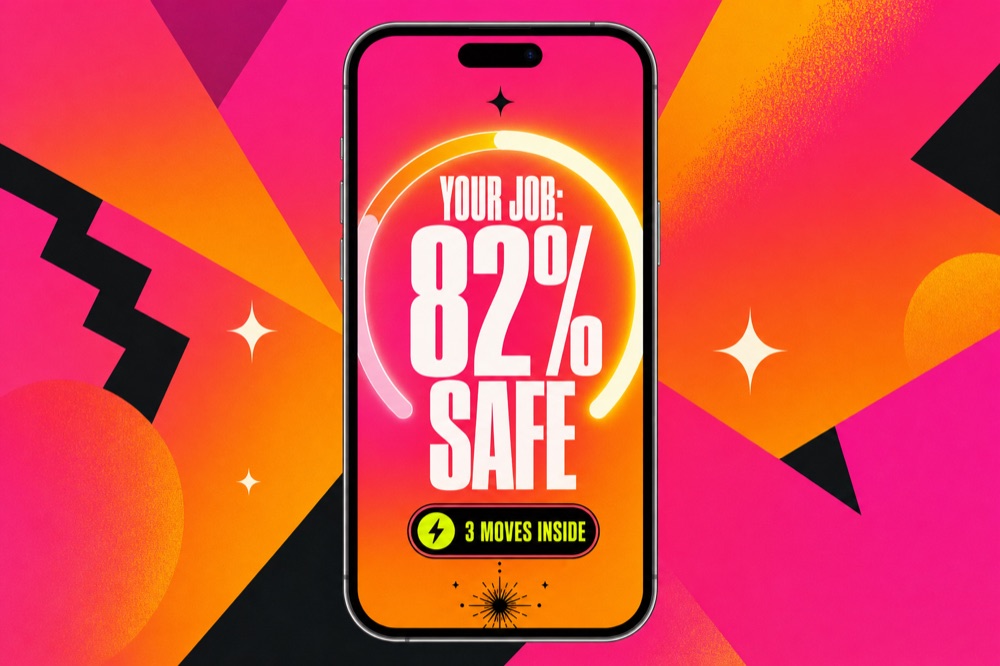
not a guess — your actual number, tonight
Everyone finishes the book asking the same thing: "Which one am I?"
Stupid Humans, Smart Machines makes one argument: what AI actually replaces is the robot-work you were trained to do, and the people who win the next decade hand the machine its half and go all-in on their own.
Readers reach the last page and ask the same thing: which parts of my week are robot-work? Which of my strengths sit on the durable side of the line? Am I a director stuck doing analyst work — or someone whose real seat doesn't share a hallway with the current one?
The book can draw the line. It can't see where you're standing relative to it. That takes an instrument. So we built one.
— Christian Martin · Author, Stupid Humans, Smart Machines
Career tests are still matching people to jobs that won't exist in five years.
| The old apparatus | This assessment |
|---|---|
| "What's your type?" | What's your move? |
| Matches you to job titles from a database of the past | Maps your strengths against where work is going |
| Treats your whole job as one thing to keep or lose | Splits your actual work into what to hand AI and what to own harder |
| Ends at a label | Ends at a plan, with a coach to run it |
The 15% Fix: find it, map it, fix it.
Find your 15% — 20 minutes.
Multiple choice. No essays, no wrong answers, nothing to prepare. It reads how you're actually built — and the one thing no personality test has ever asked: what your week really looks like.
That's the whole job. Tap answers on your phone tonight; it does the rest.
Get the map — tonight.
Your score. What to charge more for. What's been eating your week — and what to hand to AI on your own terms. If the seat is wrong, it says so, with the careers next door that fit who you already are.
Everything is about you — scored against where work is going, not generic advice.
this is a sample — your real numbers land tonight
Fix it — 30 days with your coach.
It's read your entire file before your first message. For 30 days it works the fix with you: entrepreneurs use it every morning to align the day, careers use it to sequence the hand-offs — until the 15% is off your plate.
30 days, included — a program that ends, not a subscription that lingers.
Her org chart was one contractor. Her revenue was eight figures.
We didn't theorize this framework. We watched it. Shoshanna crossed $10M with essentially herself and a single contractor, in an industry where everyone at her level runs a team of twenty or thirty. Same market, same effort, completely different shape. She was aligned — doing only the work that was distinctly hers — and everything else was systematized or handed to machines.
You don't need her outcome for the mechanics to work. They're the same at every scale: find what's yours, amplify it, hand off the rest.
For $199: The 15% Fix — assessment, report tonight, and 30 days with a coach who knows your results.
The AI-Proof Career Assessment ~20 MIN
The full battery — personality, career interests, strengths, work values, and your role's actual task-mix. Built on validated psychometrics, scored against the AI transition.
Your Alignment Report SAME DAY
Your Alignment Score, your automate/amplify breakdown (your real 15%, named), and your ranked career matches if the data says you're in the wrong seat. Every section computed from your results — not a template with your name inserted.
Your AI Career Coach 30 DAYS
It has read your entire profile and carries it into every conversation for 30 days. Ask it Sunday night what to automate Monday morning. It knows the framework, and it knows you — a program that ends, not a subscription that lingers.
Afraid it'll tell you to quit? Most reports say stay — then show you what to change.
Price doesn't stop most people here. The verdict does: what if it tells me something I can't afford to act on? So look at what it actually does. The two-path design never hands you a cliff. If you're aligned, you get an amplification plan for the career you already have. If you're not, your matches are filtered for reachability — your income, your obligations, and your actual life are constraints the plan respects.
"How can a test know what AI is going to do?"
How can a test know what AI is going to do?
I've taken Myers-Briggs. It changed nothing.
Couldn't I just ask ChatGPT?
What exactly is the AI Career Coach?
What if I love my job?
What if it tells me nothing new?
Is my data used to train anything?
Keep researching, or spend 20 minutes and know.
The honest alternative: keep reading the articles, keep the tabs open, keep the same Sunday-night conversation with yourself. A year of that costs $0 and one more year. Or spend 20 minutes and know where you stand, what to hand off, what to double down on, and whether the seat is yours. The people who come through this transition well found out where they stood before the market told them.
Tonight you'd already have the report.
Find out where you stand in the next 20 minutes.
The line between the people machines replace and the people machines promote is being drawn right now. The only question this page asks is whether you'd rather know where you stand or keep guessing.