The new rules of money, work & worth · read the whole book this afternoon for $4.99
For the ambitious — not the afraid

Everyone is using AI.
Most people are just
lying about it.

The rules of money, work and worth just changed.

Get the book — $4.99 Instant access · the full book in your inbox in 60 seconds
★★★★★ 4.8 · 367 early readers · 30-day guarantee · instant delivery
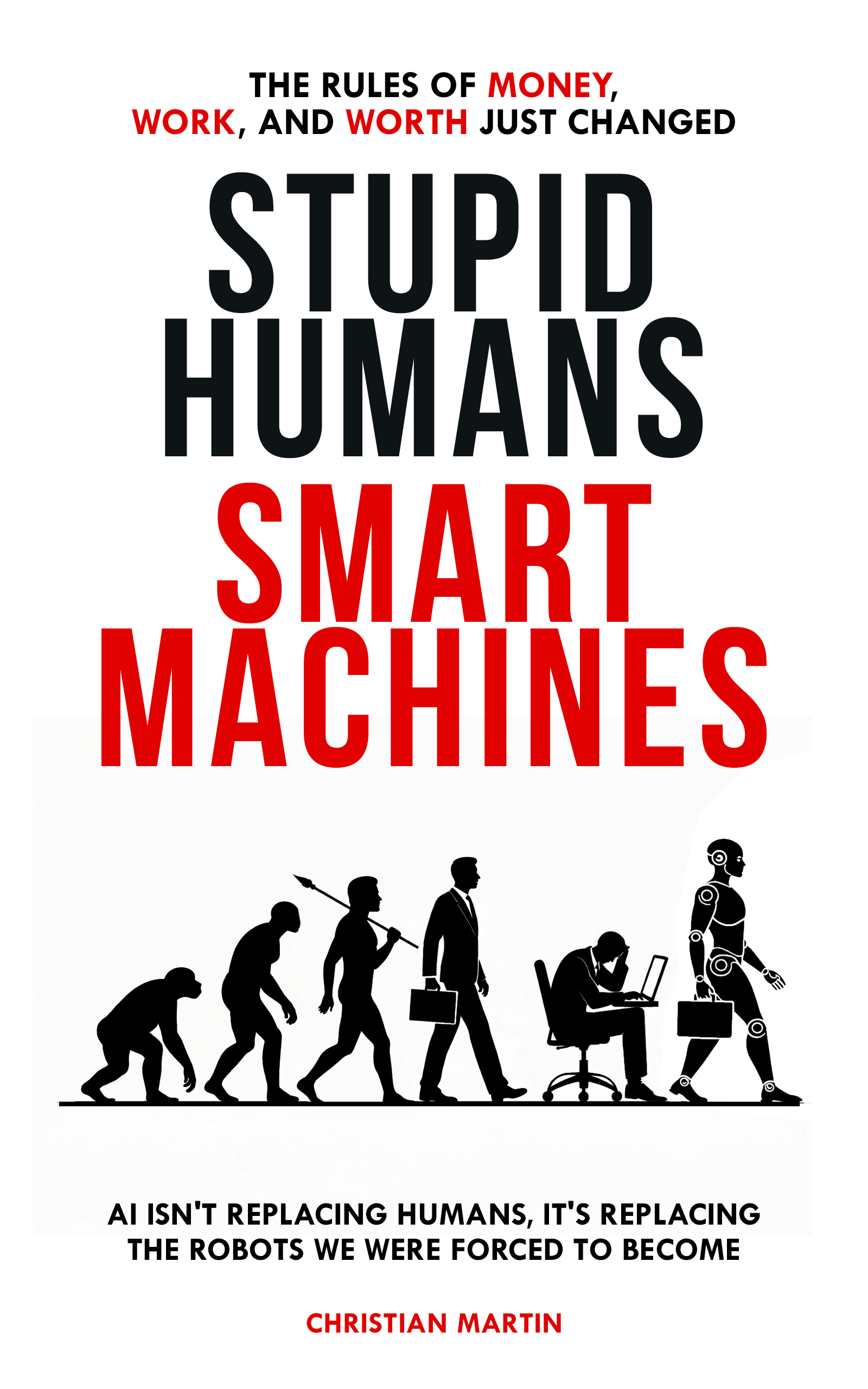
Stupid Humans, Smart Machines book cover
#1 NEWRELEASE
read in
one sitting
The revelation

AI isn't replacing you.
It's replacing the robot you were forced to become.
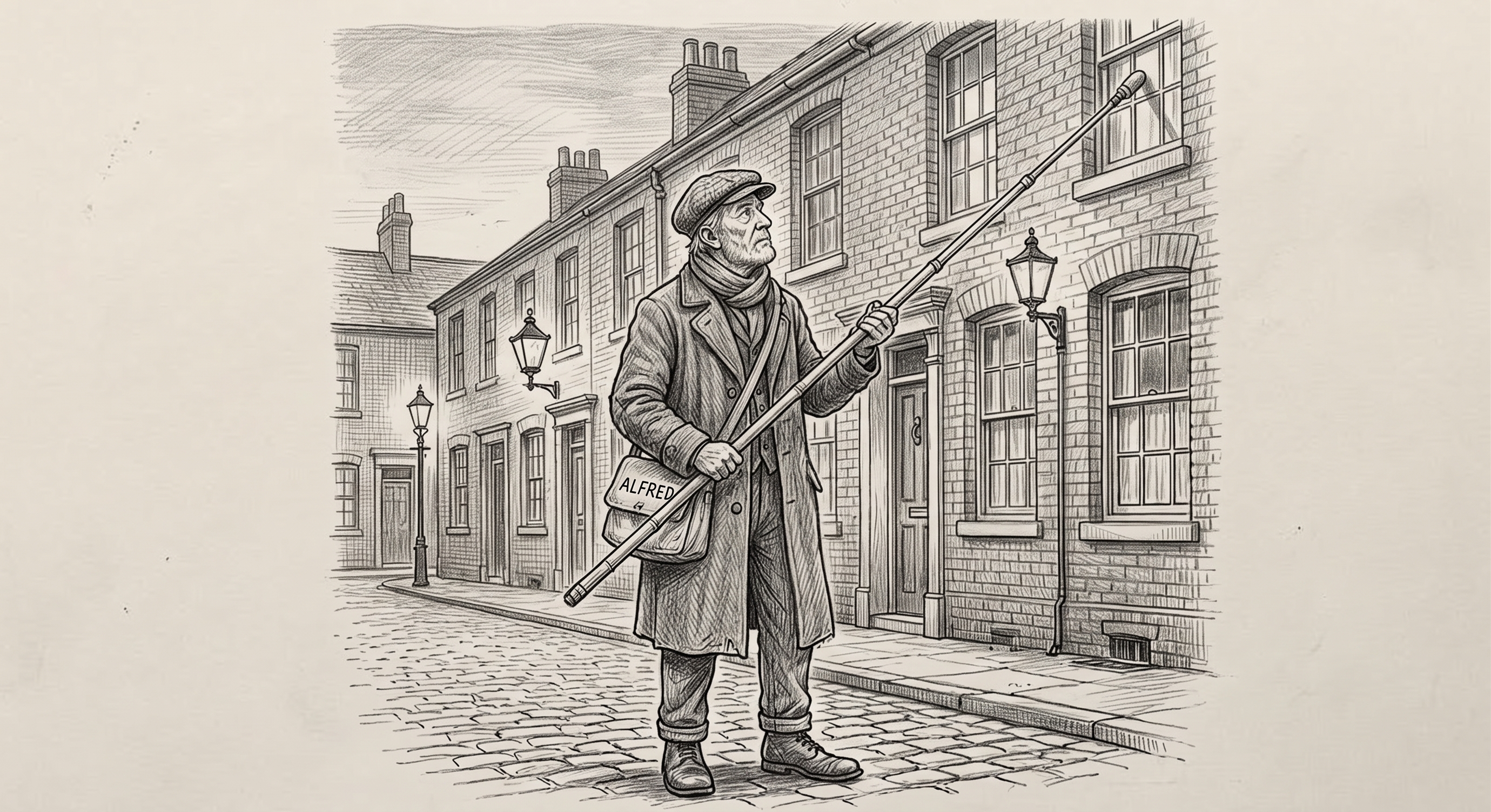
Manchester, 1920
Alfred the knocker-upper
ALFRED PRITCHARDmade obsolete
A human alarm clock · 01

In 1920, Alfred tapped on your window at 5 a.m.
so you wouldn't oversleep.

He was a "knocker-upper" — a human alarm clock. Reliable. Consistent. A man paid to do, by hand, a thing a cheap machine would soon do better.

Then his wife brought home an alarm clock. Within a year, half his customers were gone. Within ten, the job didn't exist.

Alfred didn't lose because he was bad at his job. He lost because nobody told him the alarm clock had arrived.

The assembly line never went away.
It just moved into your inbox.

For 100 years, you've been Alfred — trained from preschool to sit still, follow instructions, and run tasks on a schedule. The status report. The spreadsheet you rebuild every Monday. The deck. The follow-up email. You got good at it. That was the robot. And that's the part AI is coming for.
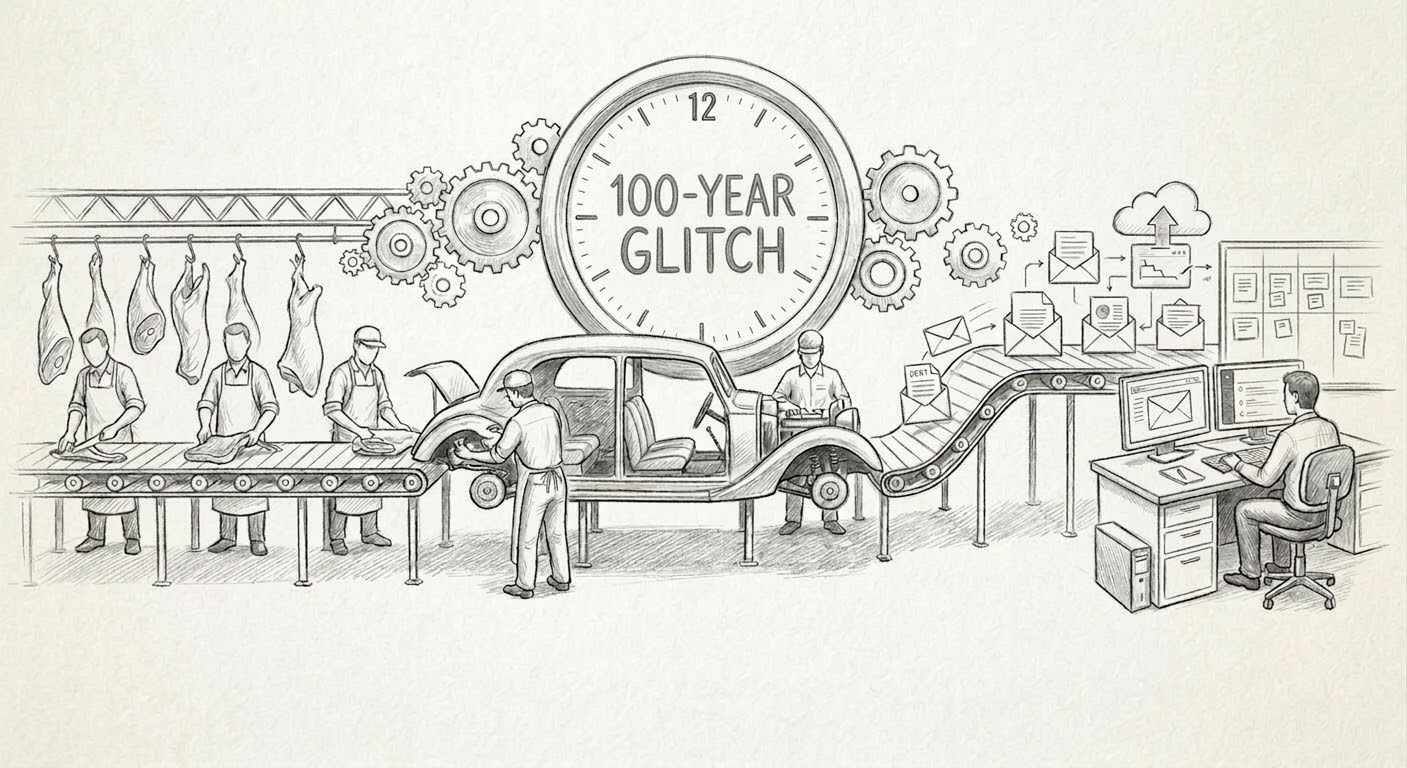
The assembly line that moved out of the factory and into your inbox

It was never coming for you. It's coming for the robot — and it's about to hand you back the part that was always worth keeping.

You don't have to say these out loud.
You just have to notice the ones that are true.

1

You're already using AI more than you admit — and quietly wondering whether that makes you safer, or more replaceable.

2

You've watched someone with half your experience pull ahead this year, and you can't quite tell how they're doing it.

3

The thing you spent a decade getting good at is starting to feel like something a machine could do in an afternoon.

4

There's a Sunday-night dread you can't fully explain — a sense that the way you've been working isn't the way a life is supposed to feel.

5

Every "AI" take you find is either doom ("you're finished") or hype ("10 prompts to riches") — and none of it tells you what to actually do.

6

If you run a business, you can feel a smaller, faster, AI-native version of it forming somewhere — and it isn't yours.

7

You look at your kids and wonder what on earth you're supposed to be preparing them for.

8

Part of you is afraid AI will take everything. And a quieter part is afraid it won't — and you'll stay exactly where you are.

Every box you checked is a symptom of the same thing.
You've been living on a 100-year-old assembly line.
And it just got automated. The people who step off it first will own the next decade.

Most people are protesting
their own promotion.

Honey poured into the ATM keypad — sabotaging the machine

When the ATM arrived, a bank teller named Sharon and her friends snuck out at night and poured honey into the keypads to break the machines. They thought they were protecting their jobs. They were sabotaging their own promotion — to the one role a machine couldn't fill: the human who sits across the desk and says "let me walk you through this."

Right now, someone in your industry is pouring honey on the keys. And here's what almost nobody understands: when you let AI take the tasks, what's left over isn't nothing. It's your actual job — the judgment, the relationships, the decisions. That's a promotion. But you have to accept it.

The question isn't whether the promotion is coming.
It's whether you'll reach for it — or pour honey on the keys while someone else takes it.

Most people trash AI in public.
Then use it in private to win.

Ben Affleck went on one of the biggest podcasts in the world and trashed AI — "I just can't stand to see what it writes… I don't think it'll ever write anything good." Meanwhile, he's an outspoken believer in using AI to gut the cost of filmmaking — the post-production, the VFX, the work that used to take rooms full of people and millions of dollars. Publicly anti. Privately profiting. He's not the villain here. He's the tell — for what's happening on every team, in every group chat you're in.

Ben Affleck calling AI bullshit on the podcast
In public: “AI is bullsh*t”
The very next week
$600,000,000

Netflix buys an AI post-production company — the same week he called it “bullsh*t.”

The creative
Caught
THE CREATIVE
"AI can't do real
creative work."
Posts about "human craft" and "soul you can't automate." Charges premium rates for original thinking.
Drafts every concept with AI, then polishes by hand. Ships 3× the work in half the time — and tells no one how.
The executive
Caught
THE EXECUTIVE
"We're being cautious
about AI here."
Tells the team AI is "interesting but not core." Keeps the headcount, keeps the process.
Runs every board deck, every memo, every strategy doc through AI first. Quietly does the work of three people — and takes the credit for all three.
The professional
Caught
THE PROFESSIONAL
"My field needs
a human, always."
Reassures clients and colleagues that "you can't replace real expertise." Leans on the credential.
Uses AI for the research, the first draft, the analysis — the exact work the credential used to be for. Saw the writing on the wall first. Said nothing.

The best people in every field already work this way — quietly, without apology. The only question is how soon you decide to join them.

The mechanism

The winners won't be humans.
Or AI. They'll be hybrids.

A hybrid — what this book calls a Centaur — is a human who directs AI instead of competing with it. Half human judgment, half machine horsepower. Unbeatable by either one alone.

The Centaur — a horse's body (AI horsepower) joined to a thinking mind (human judgment)

In 1997, IBM spent $100 million on a supercomputer to beat the world chess champion. It worked. The headlines declared it over — the machines had won, human intellect was obsolete.

IBM's Deep Blue vs reigning champion Garry Kasparov

So the champion, Garry Kasparov, invented something new: Advanced Chess — a human and a computer playing together, as one. The chess world nicknamed them Centaurs, after the half-human, half-horse creature.

Then came the real test: an open tournament. Solo grandmasters. Solo supercomputers. Centaurs. Everyone assumed a grandmaster with a computer would crush the field.

It was won by two twenty-something amateurs from New Hampshire. On three off-the-shelf laptops. They beat the best humans on earth and the most powerful machines on earth.

Not because they were better at chess. Because they'd figured out the one skill that now matters most: how to direct the machine while keeping what makes a human valuable. The horse brings the power and the execution. The human brings the aim, the judgment, the taste. The horse can run a hundred miles but doesn't know where to go.

And here's why it matters for you, not a chess board: becoming a Centaur gives an ordinary person the kind of on-call brain trust that used to belong only to the rich — the lawyers, analysts, strategists, and advisors the wealthy always had on speed dial. For your career. Your business. Your family. For the first time, available to anyone with a laptop and the skill to direct it.

Three people walk into the next five years.
Only one walks out ahead.

Same intelligence. Same degree. Same starting line. The only thing that separated them was a handful of traits — and one of them had no idea they were even being tested.

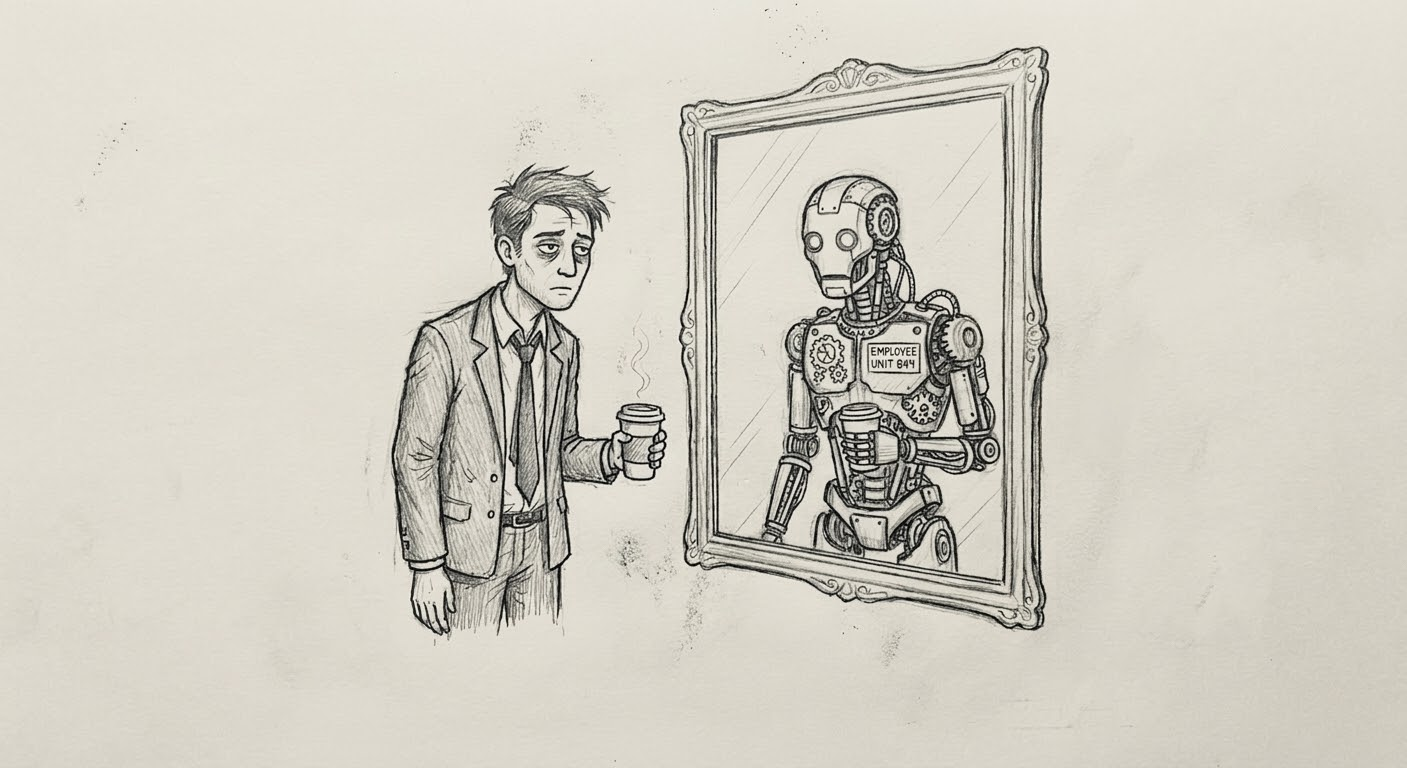
The three versions of you staring back from the mirror
Version 1

The Robot

  • Believes their value is following the process, perfectly
  • Asks "will this take my job?"
  • Waits to be told the next step
  • Competes with the machine at machine-work
Already obsolete. Just hasn't been told yet.
Version 2

The Luddite

  • Denies the tool. Clings to "the human touch"
  • Posts the angry takes. Waits for regulation
  • Hopes that if they ignore it, it goes away
  • It won't
A dead end. The market never rewards pretending.
Version 3

The Centaur

  • Asks "what could I do if I could do anything?"
  • Doesn't compete with the machine — orchestrates it
  • Moves before anyone gives permission
  • Does the work of thirty, and gets to be human again
Holds the greatest leverage in human history.

Here's the part almost nobody can see yet: becoming the Centaur has almost nothing to do with how smart you are, what your degree is, or how hard you're willing to work. When the machine can do anything you ask, the thing that decides everything is a single trait — one they never taught you in school.

The jail-cell test
A prisoner in a foreign jail cell handed a single phone — one phone call

You're thrown in a foreign cell. One phone call. Who do you call? Not the smartest person you know. Not the one with the most degrees. You call the one who gets it done — finds the loophole, wakes the ambassador at 3 a.m., bends reality until you're free. In the age of AI, that single trait is worth more than any skill on your résumé. The book names it — and shows you exactly how to build it, even if you weren't born with it.

That's one. Inside, you'll also find:

  • Why the exact trait that earned you every promotion until now is the one that gets you replaced next — and what quietly takes its place as the thing that pays.
  • The 30-second test that tells you which of the three people you are today — before the market decides for you.
  • The careers that survive the next five years — plus the new ones, with no names yet, about to make ordinary people wealthy the way "website designer" did in 1996.
  • How one operator now out-produces a team of thirty — and why most businesses will feel this as a threat instead of the unfair advantage it actually is.
  • What to tell your kids — so they're raised to be Centaurs, not trained (like you were) to be obsolete before they graduate.

Every one is answered in the book. And the moment you see them, you can't go back to not knowing.

The other side

And yes — you'll be richer.
The studies that said money can't buy happiness were wrong.

Post-scarcity abundance on the other side of the transition

You've heard it your whole life: money doesn't buy happiness. After $75,000 a year, more stops mattering. Lottery winners end up no happier.

All of it has quietly been debunked. The famous lottery study? 22 people, in 1978. The $75K ceiling? Kahneman — the same researcher — re-ran it with better data and reversed himself. The newer, larger studies found that for 80% of people, happiness keeps climbing with income — with no plateau at all. For the happiest, it accelerates.

So drop the guilt: wanting more, building more, living in more abundance isn't shallow. And it's hard to picture the life of abundance while you're still trapped in the jobs of scarcity — the same way your grandparents could never have pictured "creator" or "Airbnb host" as a living. Those only became possible after the old work was automated away.

The life on the other side of this would look like science fiction to the richest man who ever lived. That's not the doom timeline. That's the base case — for the people who cross as Centaurs.

Stupid Humans, Smart Machines
The book

The book that explains the next ten years —
before they happen to you.

It won't teach you to use ChatGPT. It does what the tutorials can't: it explains what's actually happening to money, work and worth — and exactly what to do about it before everyone else catches on.

Read it in an afternoon. Then watch the next ten years start to make sense.

5
Acts that map
the transition
25
Chapters —
no fluff
10
Commandments
to win the shift
3 hrs
Reading time.
Lifetime impact.
From the first readers

367 people read the early copy.
Here's what they did next.

Sarah K.
Creative director · Austin
VERIFIED
"I'd been quietly using AI for a year and hating myself for it — like I was cheating at my own craft. This book reframed the whole thing. The robot dies, not me. I produce three times what I used to and I finally stopped feeling guilty about how."
Marcus D.
VP, financial services · Brooklyn
VERIFIED
"The jail-cell test rearranged my whole idea of what I should be good at. I've spent 20 years being the smartest guy in the room. Turns out that's not the trait that wins anymore. Read it in one sitting on a flight — it's the clearest thing I've read on what's actually coming."
Priya R.
Physician & mom of two · Seattle
VERIFIED
"Finally an AI book that isn't 'here are 50 prompts' and isn't 'AI will replace everyone.' It's the actual argument. Honestly the part that stuck with me most was what it means for my kids — I've completely changed how I talk to them about the future."

You'll recognize yourself
in at least one of these.

Yes, if you're…

  • An owner or founder who can feel a smaller, faster, AI-native version of your business forming somewhere — and wants to be the one holding the leverage, not the one disrupted by it
  • A high earner or executive quietly wondering whether the thing you're great at is the thing that still pays in five years
  • A professional — lawyer, doctor, analyst, creative, engineer — watching AI start to do the exact work your credential was supposed to protect
  • Already using AI in secret and ready to stop feeling guilty and start compounding it openly
  • A parent who refuses to raise their kids for a world that won't exist
  • Anyone tired of AI content that's either doom ("you're finished") or hype ("10 prompts to riches") — and wants the strategic argument underneath both

Not for you if…

  • You're looking for a "100 ChatGPT prompts" cheat sheet — this is strategic, not tactical
  • You want a step-by-step "how to use Claude / ChatGPT / Cursor" tutorial — go to YouTube for that
  • You think you can wait this out and the shift will pass
  • You want to be told everything's fine and nothing's changing — it is, and it's not
Christian Martin
CHRISTIAN MARTINAUTHOR
Christian Martin · author

He lost $250,000 betting on a team.
He won it back in an afternoon with AI.

Christian's run multiple businesses end-to-end — a top-10 iPhone app, a multi-million-dollar education company from 25 countries, and AI software with 10,000+ customers. Multi-time Two Comma Club winner. He's the guy who, in 2020, sunk $250,000 over two years into an overseas dev team for a product that never shipped — and in 2024 rebuilt that exact product by himself, in one afternoon, using AI.

That afternoon is what this book is about. Stupid Humans, Smart Machines is the argument he wishes someone had handed him before that $250K mistake — for anyone who wants to be on the right side of what's coming, whether you're an employee, an owner, or building something new.

— Christian
Launch price: $4.99 — the lowest it will ever be.
This is the introductory price for the first readers. It goes up when the timer hits zero.
02DAYS
14HRS
32MIN
07SEC

You've read this far.
You already know what to do.

Stupid Humans, Smart Machines
The whole book — instant access
  • Stupid Humans, Smart Machines — full eBook284 pp
  • PDF · ePub · Kindle — read on any device
  • 5 acts · 25 chapters · read it in an afternoon
  • Yours for life
Launch price · first readers only
$4.99
Instant digital delivery · 30-day money-back guarantee
Yes — send me the book ($4.99) Instant access · charged once · no subscription

The full book, delivered to your inbox in under a minute.

30
DAY
GUARANTEE

Read it this afternoon. If it doesn't change how you see the next ten years — keep everything and I'll refund you.

Read the book. If, 30 days from now, you can honestly tell me it didn't reframe how you think about the next 5 years of your life and work, just email me and I'll refund every penny — and you keep the book anyway.

The risk is entirely on my side. I know what happens when people actually read this.

— Christian

Questions

Fair questions.
Straight answers.

Do I need to be technical?+

No — this is the opposite of a tech book. The Centaur's job isn't to understand the machine, it's to direct it. The whole point is that the most valuable skill left is the most human one.

Is this just AI hype?+

It's the opposite. Most AI content is either doom ("you're finished") or hype ("ten prompts to riches"). This is the strategic argument underneath both — why the transition is happening, what it does to work, money, and meaning, and how to be on the right side of it. No magic prompts. A new way to see.

Aren't AI books outdated the day they're printed?+

A how-to book is. This isn't one. Specific tools change every quarter; the strategy — the line, the Centaur, agency, abundance — doesn't. That's the whole reason it's an argument and not a tutorial.

I'm too old / too late for this.+

Alfred thought so too. The transition is just starting — being early to understand it is the entire advantage. The people who feel "too late" today are the ones who'll look early in three years.

What exactly do I get for $4.99?+

The full 284-page book — Stupid Humans, Smart Machines — in PDF, ePub, and Kindle, delivered to your inbox in under a minute. Yours for life. Charged once, no subscription.

What if it's not for me?+

It's $4.99 and an afternoon. If it doesn't change how you see the next ten years, reply to your receipt within 30 days and we'll refund you — and you keep the book.

Stupid Humans, Smart Machines book cover

The knocker-upper didn't lose because he was bad at his job.
He lost because nobody told him the alarm clock had arrived.

Something cheaper and more capable is now showing up for the work you do. You can fight it. You can look away. Or you can sit down with this book for an afternoon and figure out the position worth holding on the other side.

Get the book — $4.99Instant access · 30-day guarantee · read it this afternoon

See you on the other side.
— Christian